

In this guide, I will explore the Best Telescopes for Viewing Stars and Planets. First, I will explain the key features that affect performance and image quality. Next, I will highlight top picks that suit different needs and budgets. In addition, I will include a simple buying guide to help you choose the right telescope with confidence. Finally, I will answer common FAQs to clear any remaining doubts. As a result, you will have everything you need to start your stargazing journey with ease.
Best Telescopes for Viewing Stars and Planets
1) Celestron NexStar 8SE

Get it on Amazon
The Celestron NexStar 8SE is a powerful telescope built for users ready to move beyond basic setups. It combines classic design with modern technology. As a result, you get a smooth and more guided stargazing experience. It works well for viewing the Moon, planets, and deep sky objects.
First, the 8 inch Schmidt Cassegrain optics deliver strong light gathering. This allows you to see fine lunar details, cloud bands on Jupiter, and even distant galaxies. In addition, the optical tube remains compact and portable. So you get power without dealing with a bulky setup.
Next, the fully computerized GoTo mount simplifies everything. You can choose from over 40,000 celestial objects using the NexStar plus hand control. Then the telescope automatically moves to the target and tracks it. Because of this, you spend less time searching and more time observing.
Also, setup is quick and beginner friendly. SkyAlign technology lets you align the telescope using any three bright stars or planets. You do not need prior knowledge of the night sky. Within minutes, the system is ready to guide you.
Moreover, the telescope supports several upgrades. You can add accessories like StarSense AutoAlign, SkyPortal WiFi, and SkySync GPS. Therefore, the system grows with your skills over time.
In real use, the optics stand out. Saturn’s rings show clear separation. Jupiter reveals its Great Red Spot and cloud bands. Even star clusters appear sharp and detailed. At the same time, the telescope remains light enough to carry easily.
Specifications
- Optical design: Schmidt Cassegrain
- Aperture: 8 inches 203 mm
- Mount type: Computerized GoTo mount
- Object database: 40,000 plus celestial objects
- Alignment system: SkyAlign
- Weight: About 24 pounds total
- Coating: StarBright XLT coatings
- Included eyepiece: 25 mm
Pros
- Excellent image clarity for planets and deep sky objects
- Automated tracking makes observing easier
- Large object database saves time
- Portable for an 8 inch telescope
- Easy alignment process
- Upgrade options available
Cons
- Accessories feel basic
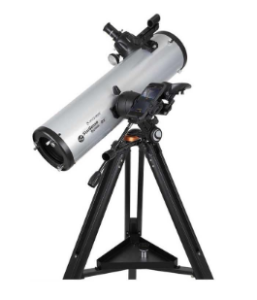
2) Celestron StarSense Explorer DX 130AZ
Get it on Amazon
The Celestron StarSense Explorer DX 130AZ is designed to make stargazing simple and enjoyable. It is ideal for beginners who want to explore stars and planets without confusion. Instead of complex controls, it uses your smartphone to guide you across the night sky.
First, the telescope connects to the StarSense Explorer app. You dock your phone, launch the app, and follow arrows on the screen. This system uses sky recognition technology to analyze star patterns in real time. As a result, it shows you exactly where your telescope is pointing. This makes finding objects much easier compared to traditional methods. Therefore, a smart choice when looking for the best telescope for viewing stars and planets.
Next, the app suggests the best objects to view each night. It considers your time and location, then creates a list of visible planets, galaxies, and nebulae. You simply choose a target and follow the directions. When the bullseye turns green, your object is ready to view.
In addition, the 130 mm Newtonian reflector provides bright and detailed images. You can clearly see the Moon’s surface, Jupiter’s bands, and Saturn’s rings. Deep sky objects like the Orion Nebula and Andromeda Galaxy also appear sharp under good conditions. Therefore, it offers a strong balance between performance and ease of use.
Moreover, the manual altazimuth mount keeps things smooth and controlled. Dual axis slow motion controls help you track objects easily as they move across the sky. Setup is quick, so you can start observing within minutes.
The telescope also includes useful accessories. You get two eyepieces, a red dot finder, and a sturdy tripod. Because of this, it is ready to use straight out of the box.
Specifications
- Optical design: Newtonian reflector
- Aperture: 130 mm 5 inches
- Mount type: Manual altazimuth mount
- Navigation: StarSense smartphone app
- Alignment: Sky recognition technology
- Eyepieces: 10 mm and 25 mm
- Finder scope: Red dot finder
- Tripod: Full height tripod included
Pros
- Very easy to use for beginners
- Smartphone guidance removes guesswork
- Clear and bright views of planets and deep sky objects
- Fast setup and alignment
- Helpful app with suggested targets
- Good value for performance
Cons
- Requires a compatible smartphone
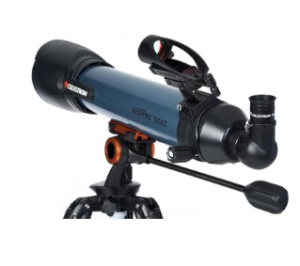
3) Celestron Inspire 100AZ
Get it on Amazon
The Celestron Inspire 100AZ is built for beginners who want a simple and reliable telescope. It focuses on ease of use while still delivering clear views of stars and planets. Because of this, it is a great choice for first time observers.
First, setup is quick and stress free. You only need to open the tripod legs and secure the accessory tray. Then attach the telescope tube using the quick release mount. Within minutes, you are ready to observe. This makes it perfect for spontaneous night sky viewing.
Next, the 100 mm refractor optics provide bright and sharp images. You can see the Moon in detail and enjoy views of planets like Jupiter and Saturn. In addition, the short tube design offers a wider field of view. This helps when observing larger objects such as star clusters and nebulae.
Moreover, the telescope includes a built in smartphone adapter. It is integrated into the lens cap, so you can easily capture images through the eyepiece. This is useful for beginners interested in simple astrophotography. You just secure your phone and start taking photos.
Another useful feature is the red LED flashlight. It is stored in the mount and can light up your accessories without affecting night vision. You can also remove it and use it separately when needed.
In addition, the focus micrometer helps you return to a specific focus point quickly. This is helpful when switching between objects. The asymmetrical mount design keeps the telescope lightweight while maintaining good stability. At the same time, erect image optics ensure a correct view for both daytime and night use. This makes it rank as one of the best telescopes for viewing stars and planets.
Specifications
- Optical design: Refractor
- Aperture: 100 mm
- Mount type: Manual altazimuth mount
- Tripod: Steel tripod with folding accessory tray
- Finder scope: Projected reticle finder
- Optics: Fully coated glass optics
- Special features: Smartphone adapter, red LED flashlight, focus micrometer
Pros
- Very easy to set up and use
- Lightweight and portable design
- Clear views of the Moon and planets
- Built in smartphone adapter for photos
- Useful red light for night viewing
- Wide field of view for larger objects
Cons
- Limited power for faint deep sky objects
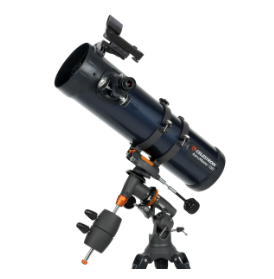
4) Celestron AstroMaster 130EQ
Get it on Amazon
The Celestron AstroMaster 130EQ is a solid choice for beginners who want more control while exploring the night sky. It offers a balance between performance and learning. As a result, it suits users ready to move beyond basic telescopes.
First, the 130 mm Newtonian reflector delivers bright and detailed views. The optics use aluminum and SiO₂ coatings to improve brightness and contrast. Because of this, you can clearly see Saturn’s rings, Jupiter’s moons, and lunar craters. In addition, deeper objects like the Andromeda Galaxy become visible under good conditions.This makes a good choice for the best telescope for viewing stars and planet.
Next, the equatorial mount adds precision. It uses slow motion control knobs for right ascension and declination. This allows smooth and accurate tracking of objects as they move across the sky. Therefore, you can keep planets centered without constant repositioning.
Also, setup is simple and quick. The telescope has only a few parts, so assembly takes just minutes. No tools are needed. The adjustable tripod adds stability and lets you observe comfortably whether sitting or standing.
Moreover, the included accessories improve the experience. You get a 20 mm eyepiece with an erect image corrector for wider views and a 10 mm eyepiece for higher magnification. The StarPointer red dot finder helps you locate objects faster. In addition, the free astronomy software helps you plan your observing sessions.
The telescope remains portable despite its size. Weighing about 17 pounds, it is easy to carry and set up in different locations. Because of this, it works well for both backyard use and darker sky sites.
Specifications
- Optical design: Newtonian reflector
- Aperture: 130 mm 5.1 inches
- Mount type: German equatorial mount
- Coatings: Aluminum and SiO₂
- Eyepieces: 20 mm and 10 mm
- Finder scope: StarPointer red dot finder
- Tripod: Adjustable full height tripod
Pros
- Bright and clear views of planets and deep sky objects
- Precise manual tracking with equatorial mount
- Quick and easy setup
- Stable adjustable tripod
- Useful accessories included
- Portable for its size
Cons
- Learning curve for equatorial mount use
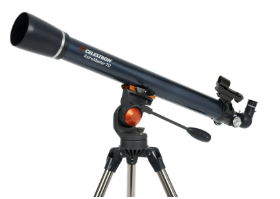
5) Celestron AstroMaster 70AZ
Get it from Amazon
The Celestron AstroMaster 70AZ is a simple and reliable telescope for beginners. It is designed for both adults and kids who want to explore the night sky without difficulty. Because of this, it offers a smooth introduction to astronomy.
First, the 70 mm achromatic refractor provides clear and sharp views. The fully coated optics improve brightness and clarity. You can easily observe the Moon’s surface, Jupiter, Saturn, and bright star clusters. In addition, the refractor design delivers a correct image. This makes it useful for both night sky and daytime viewing.
Next, the manual altazimuth mount keeps operation straightforward. You can move the telescope up, down, and side to side using the panhandle. As a result, pointing and tracking objects feels natural. This is helpful for beginners who want a simple setup without complex controls.
Also, setup is quick and stress free. The telescope has only a few parts, so you can assemble it in minutes. No tools are required. The adjustable tripod adds stability and allows comfortable viewing whether sitting or standing.
Moreover, the included accessories make it ready to use immediately. You get a 20 mm eyepiece for wider views and a 10 mm eyepiece for higher magnification. The erect image diagonal improves viewing orientation, while the StarPointer red dot finder helps locate objects faster. In addition, the included astronomy software helps you plan your sessions.
The telescope is lightweight and portable. At about 10.8 pounds, it is easy to carry and set up in different locations. Therefore, it works well for backyard use or trips to darker skies.Hence, a good option to consider when choosing the best telescope for viewing stars and planets.
Specifications
- Optical design: Achromatic refractor
- Aperture: 70 mm 2.8 inches
- Mount type: Manual altazimuth mount
- Eyepieces: 20 mm and 10 mm
- Finder scope: StarPointer red dot finder
- Diagonal: Erect image diagonal
- Tripod: Adjustable full height tripod
Pros
- Very easy to use for beginners
- Lightweight and portable
- Clear views of the Moon and planets
- Works for both day and night viewing
- Quick setup with no tools needed
- Useful accessories included
Cons
- Smaller aperture limits deep sky detail
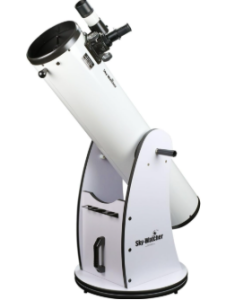
6) Sky-Watcher 8″ Classic Dobsonian
Get it on Amazon
The Sky Watcher 8 inch Classic Dobsonian is built for observers who want bright and detailed views of the night sky. It uses a simple design, yet delivers powerful performance. Because of this, it is a popular choice for the best telescopes for viewing stars and planets.
First, the large 8 inch aperture gathers a significant amount of light. This improves brightness and detail when observing faint objects. You can clearly see planets like Jupiter and Saturn. In addition, galaxies, nebulae, and star clusters appear more vivid compared to smaller telescopes.
Next, the mirrors use high quality coatings with about 94 percent reflectivity. This improves contrast and clarity. As a result, images look sharper and more defined. Even dim objects become easier to observe under dark skies.
Moreover, the Dobsonian mount keeps operation simple. It uses a manual system with smooth movement. The Teflon bearings allow easy side to side motion, while the tension control handles help maintain stability. Therefore, you can track objects without sudden shifts.
Also, the telescope includes a 2 inch Crayford style focuser. This allows smoother focusing and supports a wide range of eyepieces. You also get two eyepieces and a 9 by 50 finder scope. Because of this, the telescope is ready for use right away.
In addition, the design remains sturdy yet manageable. The tube and base together weigh about 45 pounds. While not very portable, it still offers a good balance between size and usability for home observation.
Using this telescope encourages a more hands on experience. Instead of relying on electronics, you learn to navigate the night sky manually. This can improve your understanding of constellations and object locations over time.
Specifications
- Optical design: Newtonian reflector
- Aperture: 8 inches 203 mm
- Focal length: 1200 mm
- Mount type: Dobsonian mount
- Mirror reflectivity: 94 percent
- Focuser: 2 inch Crayford style with 1.25 inch adapter
- Eyepieces: 25 mm and 10 mm
Pros
- Large aperture for bright and detailed views
- Excellent performance on deep sky objects
- Smooth and stable manual movement
- High quality mirror coatings
- Includes useful accessories
- Good value for its size
Cons
- Bulky compared to smaller telescopes
Read also: 5 Best Spotting Scope for 500 Yards
Factors to Consider when Choosing the Best Telescopes for Viewing Stars and Planets
Here are 8 well explained factors to consider when choosing the best telescopes for viewing stars and planets;
1. Aperture Size
First, consider the aperture, which is the diameter of the main lens or mirror. A larger aperture gathers more light. As a result, images appear brighter and more detailed. This is especially important for viewing faint stars and distant galaxies. However, larger apertures often mean heavier equipment. So you need to balance power with portability.
2. Optical Design
Next, look at the type of telescope design. Refractors, reflectors, and compound models all perform differently. Refractors give sharp images and need little maintenance. Reflectors offer more light gathering for the price. Meanwhile, compound designs combine both benefits in a compact form. Therefore, your choice depends on your viewing goals and experience level.
3. Mount Type
The mount controls how the telescope moves. Altazimuth mounts are simple and easy to use. They move up, down, and side to side. In contrast, equatorial mounts allow smoother tracking of objects as they move across the sky. Because of this, they are better for longer observations. However, they require more learning at the start.
4. Ease of Setup and Use
Also, think about how quickly you can set up the telescope. Some models are ready in minutes, while others take longer. Beginners often prefer simple systems with fewer parts. In addition, features like guided alignment or app support can make the process easier. This helps you spend more time observing instead of adjusting.
5. Portability and Size
Another factor is portability. If you plan to travel or move the telescope often, weight and size matter. Lightweight models are easier to carry and store. On the other hand, larger telescopes provide better views but are harder to transport. So consider where and how you will use it most.
6. Included Accessories
Accessories can improve your experience right away. Common items include eyepieces, finder scopes, and tripods. Some telescopes also include software or smartphone adapters. Because of this, a well equipped package can save you extra costs later. However, you may still upgrade accessories as your skills improve.
7. Viewing Purpose
Your main goal also plays a big role. If you want to observe planets, you need high magnification and sharp optics. For stars and deep sky objects, light gathering becomes more important. In addition, some telescopes work well for both day and night viewing. So it is important to match the telescope to your interests.
8. Budget and Upgrade Potential
Finally, consider your budget and future plans. Entry level telescopes are affordable and easy to use. However, advanced models offer better performance and features. It is often wise to choose a telescope that allows upgrades. This way, you can improve your setup over time without replacing everything.
Best Telescopes for Viewing Stars and Planets FAQs